The recovery
Recovery doesn’t have to be complete to be successful. It’s been four years since Grant’s accident. She does things differently now, but notes that change—in how we look and how we act—is inevitable as we age.
Still, she feels she’s continuing to gain skills she thought were lost. Last year, she set a physical challenge for herself: For 100 days, she would perform seven simple exercises or movements—like touching her toes or standing on one foot—100 times a day. She did 25 repetitions when she woke up, 25 repetitions before going to bed, and two other sets of 25 repetitions at some point during the day.
She struggled through some of the movements in the beginning, “but after a few weeks, a few months into it, I was not stumbling anymore.” Ultimately, she believes the exercises help her feel calm and focused. They’ve become part of her healing routine. “If I’m feeling overwhelmed by something or especially scattered, [they] put my mind back in alignment with my body,” Grant says.
Dr. Reams says exercise after a traumatic brain injury can help the brain heal because it releases chemicals that support recovery. Exercise can also improve sleep, reduce pain, and help regulate mood. “Evidence shows that early introduction of [gentle] aerobic exercise does not worsen symptoms or prolong recovery and can actually reduce symptom duration.”
Dr. Ebbert agrees, adding, “Early introduction of light aerobic physical activity has been shown to help expedite both physical and psychological recovery.”
Grant has also developed habits that help her fill in the gaps in her memory. She keeps a detailed calendar of appointments. She sets alarms on her phone as reminders. She has a teleprompter to use during concerts—but, so do friends who haven’t had a traumatic brain injury, she says. Dr. Reams says it is important patients don’t attribute all their post-injury experiences to the traumatic brain injury.
“We’re not static in life, and all kinds of things change us,” Grant says. “At every chapter, we just have to figure out the systems that help us accomplish what matters most.”
In the immediate aftermath of her accident, Grant often took a “fake it until you make it” mindset when she didn’t recognize someone or recall a story. Now she’s confident enough to ask for help recalling information. “If I’m talking with friends and they say, ‘Remember when we took that trip to so-and-so?’ and [if] I don't remember, I’ll say, ‘Keep talking about it. Let me see if I can find it,’” she says.
Or, when she sees someone and can’t remember their name, she’ll say something like, “Don’t take it personally [but] you’re going to have to tell me your name, probably three times…I know we’ve got history, but I guess those synapses snapped when I got that clonk on the head.”
Her Christian faith, too, plays a part in her healing. Grant says she recites the Lord’s Prayer and the 23rd Psalm every day. But a person doesn’t have to believe in a higher power to have hope for a better future, she says.
“I've asked myself, ‘If there were no words, do you trust that what [supports] all of life is good?’ And I do feel that. I feel goodness [supports] everything,” she says. “You can’t see a sunrise, you can’t hear a bird sing, and not [say], ‘We are all part of a bigger design that is infinite.’”
And, of course, there’s music and its incredible power to connect, explain, soothe, and heal. Dr. Ebbert says music can aid in recovery from a traumatic brain injury and he says it’s very likely that Grant’s musical inclinations have played a part in her recovery. “In the patients I have treated with musical experience, their gusto served as a beacon to help drive their individual rehabilitation and quality of life.”
Grant saw this not only with herself, but also while she was caring for her aging parents. Both had dementia, she says, and music was the last parts of their memory to fade. “My father could not remember a lyric, but there were some old church hymns that had beautiful, kind of complicated melodies. I would start humming one of those and he could do all the intervals,” she remembers. “It was in there.”
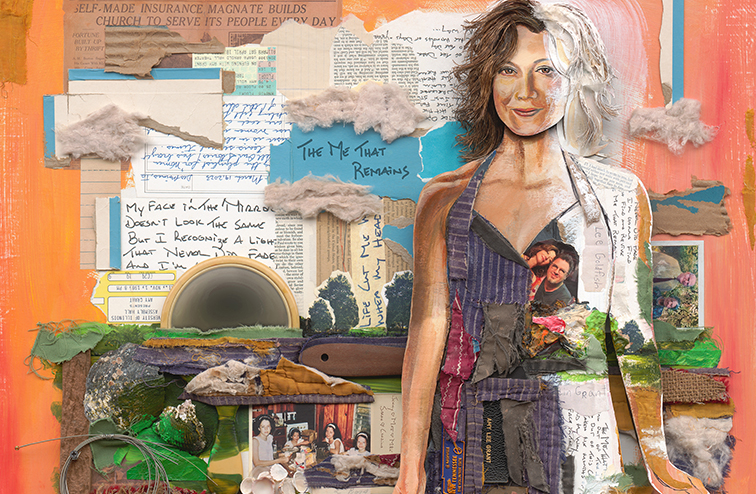
Writing new music, and sharing her story with the world, has also helped her process all she’s been through. The first verse of her new album’s title track shows both her vulnerability and her strength:
Life cut me wide open
When my head hit the ground
Wasn’t my time for dying
Guess my soul just stuck around
And out of this wreckage
I’m beginning to claim
The gifts in the healing
And the me that remains.
It’s a relatable story, she says, because “everybody's always recovering from something.”
And while you can’t control what happens, you can control how you handle trying events. Imagine, Grant says, standing on a road. If you turn in one direction, you see destruction and darkness. If you look in the other direction, you see beauty and possibility. “You have not actually changed your position on the map one inch, but it’s just where you’re allowing your gaze to land,” Grant says. “We have so much power and choice in our response to everything.”
The bike helmet that made all the difference
While in the hospital, Grant remembers a neurologist picking up the bike helmet she’d been wearing and saying, “If she hadn’t had this helmet, she would have been in the morgue.”
About a year ago, Grant was searching her cabinets and closets for a kitchen gadget when she found the bike helmet. She didn’t know how or why she’d kept it. She buckled it on her head in that moment.
“That really beautiful, heavy-duty plastic had gravel dents all over it,” she recalls. “And I [said out loud], ‘Oh my gosh. This thing protected me.’ And [then] I thought, ‘Go easy on yourself.’”
Grant didn’t climb on a bike again until March 2026. When she did, she was wearing a new helmet.
Hear more from Amy Grant
In this episode, Amy discusses her inspiring journey of recovery following a traumatic brain injury and how music continues to be a source of connection and healing. Dr. Shae Datta shares expert knowledge on concussion and TBI management, recovery, and innovative therapies, highlighting how personalized care can make a difference in prognosis.