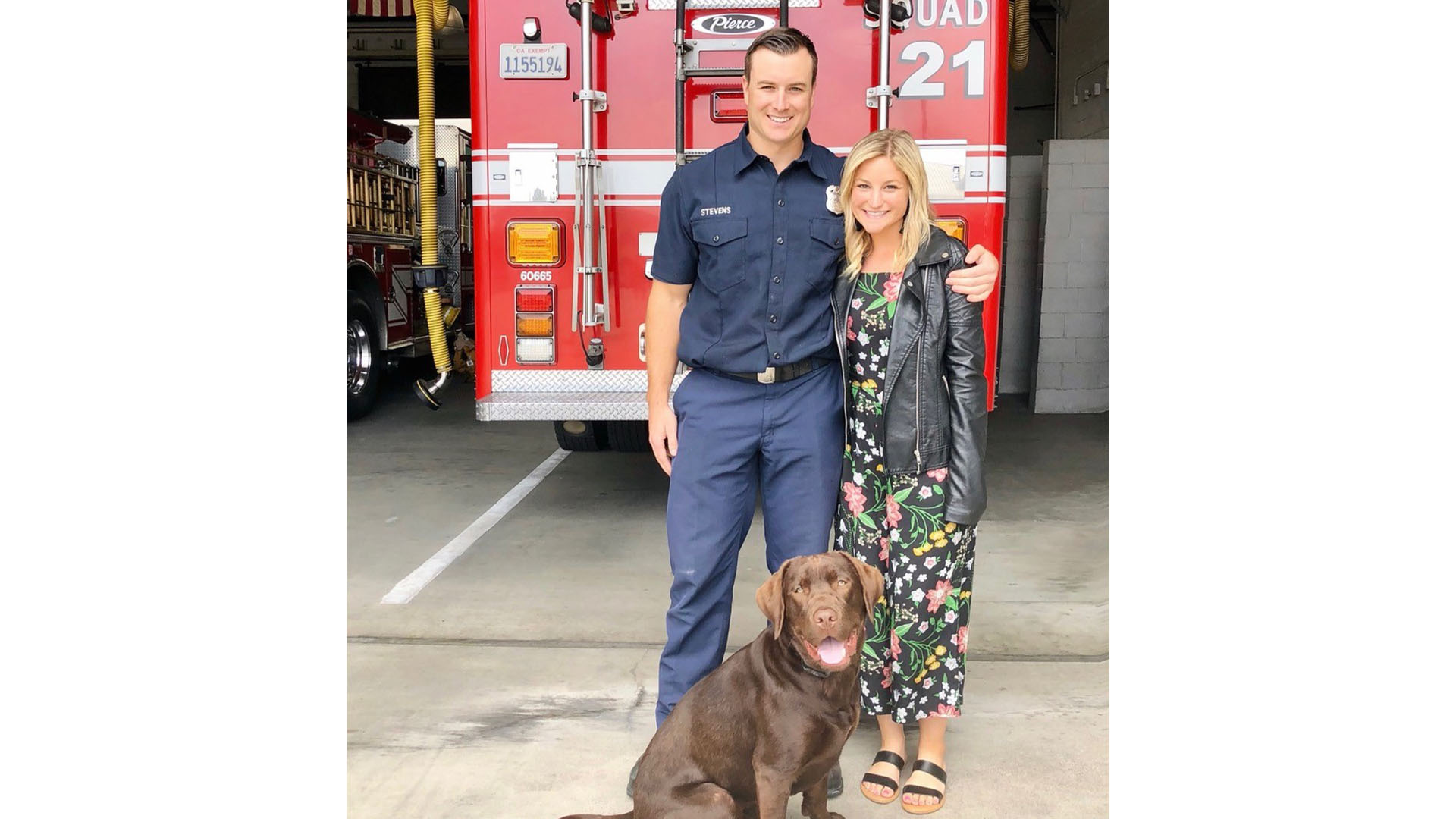
Before ALS, Eric Stevens lived a life built around his physical abilities. He played college football at University of California, Berkeley, where he was a fullback and team captain, then signed briefly with the St. Louis Rams in 2013. After that, he followed the career path of his two older brothers and spent five years fighting fires with the Los Angeles Fire Department. Off the clock, he worked out, mountain biked, surfed, fly-fished, and spent time with his girlfriend, Amanda—whom he’d met in college—and their dog, Duke. He and Amanda married. They were planning to buy a home and start a family.
But in March 2019, something changed.
Early ALS symptoms and a path to diagnosis
“I noticed several symptoms,” Stevens recalls, “overall fatigue, left hand weakness, and slowing of my speech.” He thought it might be from an old football injury or maybe a pinched nerve. But just a few weeks after his wedding and honeymoon, fasciculations—involuntary muscle twitching—began in his biceps and triceps and didn’t go away. Combined with the other symptoms, he knew something was wrong. He skipped his primary care doctor and went straight to a neurologist. “I had a gut feeling that this was a more serious neurological issue,” he recalls.
“ALS symptoms can be very subtle early on—slightly slurred speech, running more slowly, dropping a cup, for example,” says Catherine Lomen-Hoerth, MD, PhD, FAAN, a neurologist and director of the ALS Center at the University of California San Francisco Medical Center.
What followed was, in many ways, the standard ALS diagnostic odyssey, though Stevens moved through it faster than most. “The path to diagnosis often takes over a year because of all the other conditions doctors need to exclude,” notes Dr. Lomen-Hoerth.
There is no single test for ALS. Diagnosis requires ruling out other causes through a variety of tests, including MRI, blood work, sometimes lumbar puncture, and an electromyography (EMG) study. Kelly G. Gwathmey, MD, FAAN, a neuromuscular expert at Columbia University, notes that the average person with ALS sees three or four health care providers—often otolaryngologists, gastroenterologists, or spine surgeons—before seeing an ALS specialist.
For Stevens, the EMG confirmed it. He was diagnosed with ALS in August 2019. He was only 29 years old. His age made the diagnosis especially jarring—but research suggests that athletes, particularly those in contact and endurance sports, develop ALS at higher rates than the general population, though the reasons remain unclear.
“Emotionally, it felt like all of the sacrifices and hard work it took to get to that point were suddenly thrown out the window,” he says. “I had a steady career that I enjoyed, I had just married an incredible woman who is the love of my life, and we were planning to buy a home and start a family. All of that changed in an instant.”
What is ALS?
Amyotrophic lateral sclerosis, also known as Lou Gehrig’s disease (for the New York Yankees first baseman whose ALS diagnosis helped raise awareness of the disease nearly a century ago), is a progressive neurodegenerative disease that attacks motor neurons—nerve cells that tell your brain and spinal cord muscles when and how to move.
Roughly 70% of patients, Dr. Gwathmey notes, present with painless, progressive weakness in an arm or leg, which is referred to as “limb-onset” or “spinal onset” ALS. About 20% to 25% present with difficulties with speech or swallowing. This is known as bulbar-onset symptoms. A small percentage present with respiratory symptoms first. Approximately 85% to 90% of cases are “sporadic,” which means there is no family history of the disease; 10% to 15% of cases are genetic. And nearly half of ALS patients experience some degree of cognitive impairment, with 15% developing frontotemporal dementia—a condition that affects behavior, personality, and language more than memory.
Stevens describes ALS in less clinical terms. “ALS is absolutely brutal. It slowly chips away at everything that makes you human, starting with your physical ability, then your ability to communicate verbally, and eventually your ability to breathe. You slowly become more dependent on others for everything. One day it’s brushing your teeth, the next it’s getting help out of bed. Eventually you can’t move at all. As this is all happening, your mind remains sharp and clear.”
Most people with ALS pass away from respiratory failure within two to five years of symptom onset, though about 10% live longer than a decade.