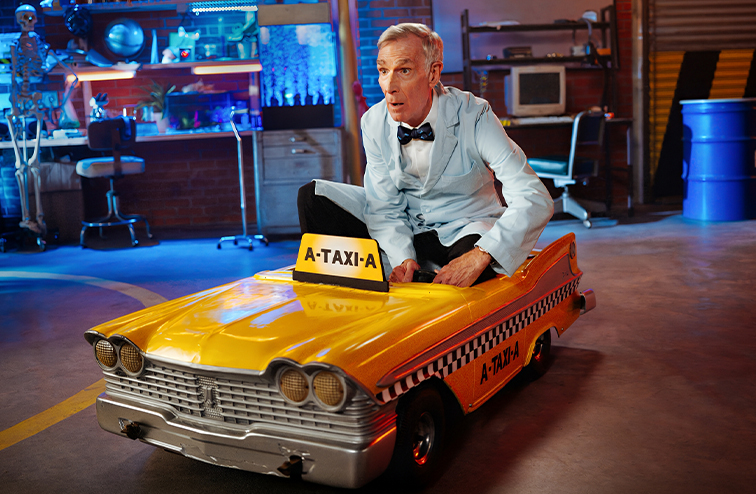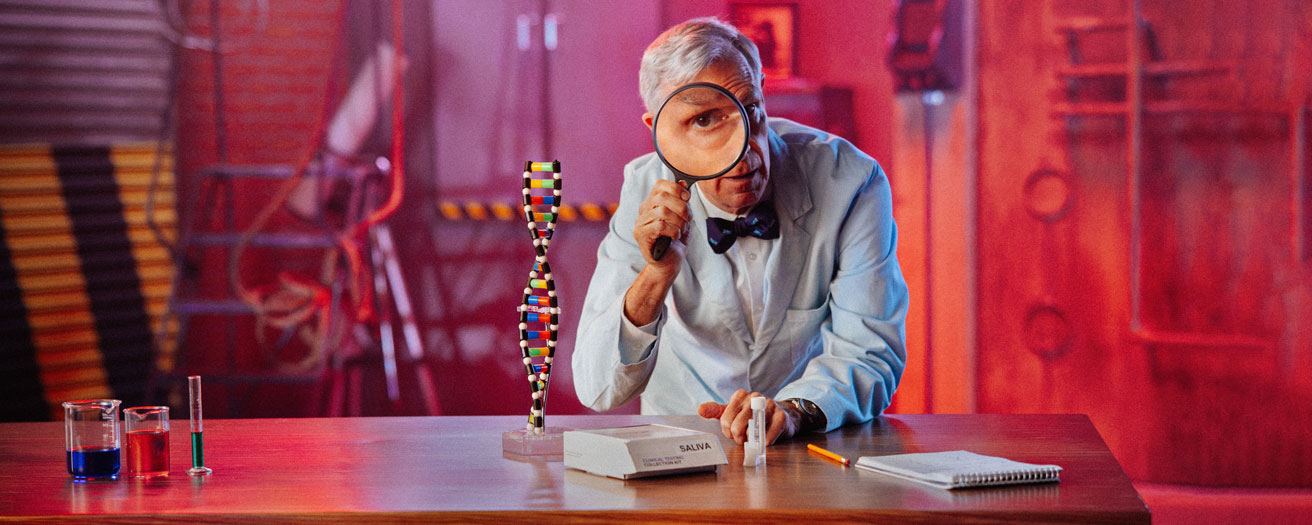
Growing up in Washington, DC, in the 1950s and 1960s, young Bill Nye inherited a passion for science from his parents. His mother, Jacqueline, was a World War II codebreaker. His father, Edwin “Ned” Darby Nye, spent several years in a Japanese prison camp during the war, where he taught himself to tell time using a shovel handle, spurring Bill’s fascination with sundials.
But there was something he did not inherit: his father’s distinctive, wobbly, gliding-like gait. “I grew up with my father falling down all the time,” says Nye, who helped generations of children and their families discover the world of science with his Bill Nye the Science Guy program. “One day I came home, and there was an ambulance in the driveway because he had fallen down the basement steps.”
Ned Nye’s motor condition was a form of hereditary ataxia, a rare degenerative condition of the nervous system that includes many subtypes. Ataxia is a neurological condition that affects coordination, balance, and muscle control. The most common form of hereditary ataxia is Friedreich’s ataxia, a genetic condition that was the first to be identified as its own disorder separate from other forms of hereditary ataxia. In addition to balance difficulties and slurred speech, people with Friedreich’s ataxia are often affected by spinal issues and heart problems that can be fatal.
But that was not the type of ataxia that ran in the Nye family. According to family lore, the condition traced back to a Massachusetts Bay Colony ancestor named Samuel Darby whose family intermarried with the Nye family back in the 17th century. “A feature of our ataxia is it doesn’t kill you. You’ll die with it, not from it, as they say. But it persists through generations, and it is passed on by a specific gene,” Nye explains.
The “Darby Glide”—what the Nye family has nicknamed the hereditary condition—has appeared regularly but unpredictably in each generation. Ned had it, as did his mother and grandmother. As Bill and his siblings grew up, his sister Susan and brother Edward Jr. both developed it—but Bill did not. Until 2023, the Nye family did not know exactly which gene was the culprit and why some family members were spared while others were affected.
A breakthrough 300 years in the making
In January 2023, two different research teams published nearly simultaneous articles identifying the cause of a previously unexplained form of late-onset cerebellar ataxia. They traced the condition to a change in the FGF14 gene that causes a small DNA sequence to repeat many more times than normal. The condition was first called SCA50 (spinocerebellar ataxia type 50) but was later renamed SCA27B (spinocerebellar ataxia type 27B). Researchers have since found that it is one of the most common inherited forms of adult-onset ataxia.
“This discovery has been a tremendous benefit to the field, as has Bill Nye’s involvement, because he is such a great spokesperson for science of all types,” says Christopher Gomez, MD, PhD, the Albina Y. Surbis Professor of Neurology at the University of Chicago and founder and director of the University of Chicago Medicine Ataxia Center.
The discovery has led to an increase in new diagnoses. “With a genetic test now available, we are learning about more and more people with SCA27B,” says Sheng-Han Kuo, MD, director of the Initiative for Columbia Ataxia and Tremor at Columbia University Irving Medical Center and a scientific advisor to the National Ataxia Foundation. “It’s a very exciting time.”
For Nye, the impact was personal. “People in my family—my nieces, nephews, cousins, everybody—can get tested,” he says.
The discovery also became his call to advocacy. He had grown up watching his father struggle with the disease but had always felt the lack of treatment options left little for an advocate to do. "My brother especially would say, 'Bill, you should use your celebrity [status] to do something for ataxia,'" Nye says. "And I would tell him, 'There isn't much you can do about it.' Until two and a half years ago. Now there's something I can do, so I'm doing it."
In 2024, he partnered with the National Ataxia Foundation, the primary patient advocacy organization for the disorder, filming a series of four short videos about ataxia and his family's experience. By the following year, the collaboration had broadened into a Congressional briefing on rare-disease clinical trials and a four-part series with the biotech company Biogen on Friedreich ataxia, bringing viewers back to Bill’s iconic “Science Guy” lab. "Two years ago, very few people I met had heard the word 'ataxia,'" Nye says. "Now I meet many people who have."