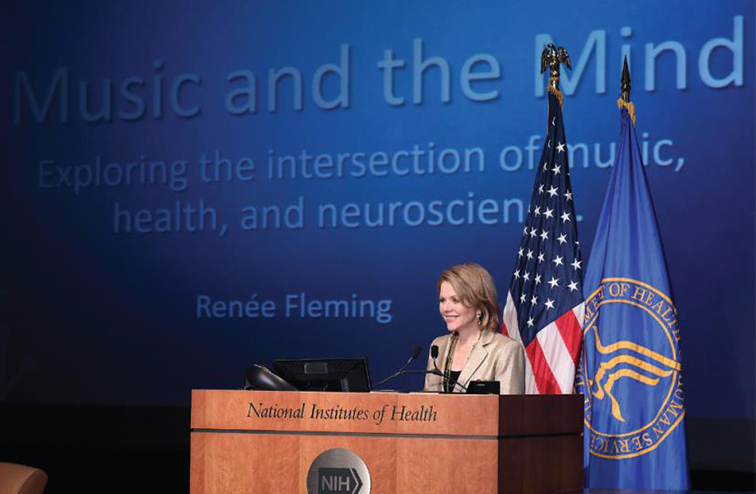
When singer Renée Fleming thrills concert audiences in New York, London, Paris, or any number of other cities worldwide, she experiences the powerful effect music has on her mood and health. “I have the privilege of being in a flow state almost every time I perform. I feel so happy and calm when I get off stage,” she says.
But it wasn't always that way. While a student at Juilliard, Fleming experienced back spasms twice before auditions. Her own research led her to an article suggesting that these episodes could occur due to psychological stress—in her case, stage fright and performance anxiety. After that realization, Fleming began reading about the mind/body connection, and she discovered that neuroscientists were looking at music and the brain.
Fleming has since learned a lot about the positive impact—including reducing stress—that music can have on the brain. She has even helped spearhead a collaboration among the National Institutes of Health (NIH), the John F. Kennedy Center for the Performing Arts, and the National Endowment for the Arts to study the subject. The joint initiative, called Sound Health, supports research into music's effect on the brain and its potential clinical applications, including treating symptoms of Parkinson's disease, stroke, chronic pain, mental illness, and more. This program led to the foundation of the Sound Health Network at the University of California, San Francisco.
Fleming's involvement in and advocacy for creative arts, health, and neuroscience resulted from her meeting then NIH director Francis S. Collins, MD, PhD, at a Washington, D.C., dinner party in 2015, where they experienced—rather unexpectedly—the healing power of music. To help break the tension in a room full of differing political views, Fleming suggested a spontaneous sing-along, accompanied by Dr. Collins, a lifelong musician, who had brought his guitar to the dinner. The communal singing, which included the folk ballad “This Land Is Your Land” and Bob Dylan's “The Times They Are A-Changin’,” worked its intended magic, with everyone, including Supreme Court justices Ruth Bader Ginsburg and Antonin Scalia (who were friends but ideological opposites), harmonizing.
That night, Fleming told Dr. Collins that she had accepted an invitation to serve as an artistic adviser-at-large for Washington's Kennedy Center for the Performing Arts. Already a National Medal of Arts winner, Fleming would receive the Kennedy Center Honors in 2023. She has mastered the most challenging roles in the opera repertoire and also earned a Tony nomination for her performance in the 2018 Broadway revival of Rodgers and Hammerstein's Carousel.
Speaking with Dr. Collins at that Washington dinner party, Fleming mentioned her long-standing curiosity about whether music could positively affect health and well-being. “I knew that scientists were studying music and wanted to know why,” she says. “Francis told me that because music affects every mapped area of the brain, he and others wanted to understand more about it.”