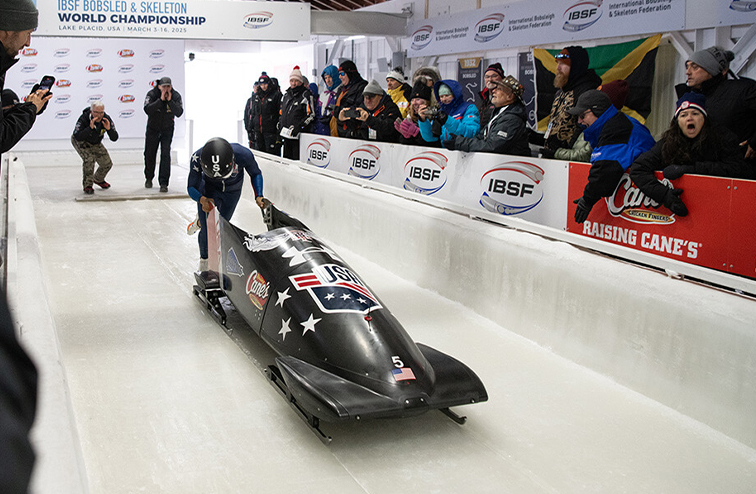
As the World Cup winter season ramps up in Europe, the ice track is quiet in the early morning, the kind of stillness that settles only before speed takes over. Elana Meyers Taylor stands near the bobsled, breath fogging in the cold air, running through the familiar pre‑run checklist—body position, reaction time, focus. The curves here are unforgiving, the speeds relentless. This winter, as she prepares for the 2026 Olympic Games in Milano Cortina, Italy, Meyers Taylor is once again doing what she has done for more than a decade: hurtling down frozen tracks at nearly 90 miles per hour, trusting her instincts, her training—and her brain.
At 41 years old, Meyers Taylor is one of the most decorated bobsledders in US history, with five Olympic medals across four Winter Games. She is also the most decorated Black winter Olympian of all time. But alongside the medals and the speed, her career carries another defining chapter: a concussion sustained during a violent crash in Germany during the 2014–2015 season. It was an injury she initially played down, raced through, and only later understood for what it was.
A crash, and a choice to keep racing
The crash happened in January 2015, on a day when “the track was faster than it had ever been,” she recalled. Track speed can change significantly based on ice conditions, temperature, and how the course is prepared. On particularly cold days, harder, smoother ice reduces friction, allowing sleds to travel faster. Meyers Taylor had just broken the track record by more than a second—an enormous margin in bobsledding—when she came out of a 360‑degree turn known as the “Kreisel” and missed a steer. The 380‑pound sled went airborne on the second bend, crashing back to the ice before she had time to tuck her head under the front as she’d been trained.
"It’s as simple as opening and closing my hand,” she said. “We flipped on our side. I hit my head on the curve, and then the sled whipped back up.”
She finished the run anyway, still fast enough for sixth place. At the bottom, though, she felt disoriented and overwhelmed. “I was completely out of it,” she said. “I immediately asked my team doctor to get me out of there.”
She underwent medical evaluations and passed cognitive tests. Imaging scans were clean. Because she wanted to race, and because she tested well, she was cleared to return to competition within days. Looking back, Meyers Taylor is candid about how that decision came about. “I convinced myself I was fine,” she said, “And I convinced everyone around me.”
What made her case especially difficult to recognize was that she continued to perform at an elite level. She went on to win a world championship soon after the crash. “I had to wear goggles to dim the lights. I wore sunglasses even during warmups. I don’t remember much from driving those races. But I was still winning.”
That disconnect between outward performance and internal injury is not unusual in concussion, said Javier Cárdenas, MD, FAAN, a sports neurologist at the West Virginia University Rockefeller Neuroscience Institute and vice chair of the NFL’s Head, Neck, and Spine Committee. “Concussion is a clinical diagnosis,” Dr. Cárdenas said. “There is no single test that tells you ‘yes’ or ‘no’. You can have normal cognitive scores and still have a concussion.”
Neurologists rely on a combination of factors: a detailed history of the injury, reported symptoms such as dizziness or light sensitivity, cognitive testing, balance assessment, and evaluation of eye movements. “That multimodal approach is critical,” he said, “because not all components will be abnormal in every patient.”
In elite athletes, another factor complicates diagnosis: motivation. “Athletes want to get back,” Dr. Cárdenas said. “If they don’t report how they’re feeling, the tests become much less sensitive.”
For Meyers Taylor, the symptoms that lingered most were not cognitive, but emotional. “Mood changes were huge for me,” she said. “Cognitively, I was great. That’s part of why nobody realized what was going on.”
Mood changes are a frequently overlooked aspect of concussion, said Brian Hainline, MD, FAAN, a neurologist at NYU Langone Health and former chief medical officer of the NCAA. “When people think about concussion, they think about headaches and thinking problems,” Dr. Hainline said. “But irritability, anxiety, and depression are brain‑based symptoms, too, and they’re incredibly common.”
Concussion can also worsen conditions that are already present, such as migraine or anxiety. “If you don’t address the behavioral aspects, you’re not treating the whole person,” he added.
A tipping point
After the world championships, Meyers Taylor took time off and began to feel better. But the following season, during a race in Altenberg, Germany, she experienced something new.
“I felt like I blacked out in the middle of a curve. That’s when it was finally like, ‘Okay, something’s really not right.’” Her coaches pulled her from competition. “I thought my bobsled career was over,” she said.
She was referred to a specialized concussion rehabilitation program, where clinicians identified issues with eye tracking, neck stability, autonomic function, and nutrition. The multidisciplinary approach to recovery included targeted visual and vestibular exercises to address impaired eye movements and spatial processing, balance and coordination retraining, and therapies aimed at regulating autonomic nervous system (“fight or flight” response) dysfunction. Her team also evaluated her cervical stability and addressed neck-related contributors to her symptoms, while monitoring sensory sensitivity and reaction time.
"We worked on everything from vagus nerve stimulation to making sure my vitamin levels were right,” she said. Noninvasive vagus nerve stimulation uses external techniques to activate a nerve that helps control involuntary functions such as heart rate and stress, with the goal of restoring autonomic balance after concussion. For a month, she did no formal training. “No weightlifting. No running. Just recovery.”
While elite athletes may have access to specialized care, many elements of concussion recovery are broadly applicable, explained Dr. Cárdenas. “After a brief period of rest—24 to 72 hours—physical activity becomes part of the treatment,” he said. “Sub‑symptom threshold exercise is actually therapeutic for the brain.” Excessive restriction can worsen anxiety and depression. A gradual, supervised return to activity, without risk of head impact, is now standard care.
Dr. Hainline emphasized the importance of recognizing “persisting symptoms,” a term that has replaced “post‑concussion syndrome.” “Persisting symptoms don’t mean the concussion was more severe,” he said. “They mean those symptoms need targeted treatment.”