
Stage lights, flashing cameras of paparazzi, air travel, and adoring fans seeking selfies are all in a day's work for actress and singer Kristin Chenoweth. They're also the reasons the Broadway legend, recording artist, and TV star almost retired in her thirties.
The performer says light, even from a smartphone's tiny camera, can bring on a migraine with aura—a temporary visual loss or disturbance—intense nausea, and crippling head pain, as well as room-spinning vertigo. Now 51, Chenoweth has battled these symptoms half her life.
Her first attack happened mid-performance with the Virginia Symphony when she was 25. She lost peripheral vision and saw strobing flashes, or what she refers to as "kaleidoscope eyes." The viselike head pain that followed left her "crawling off the stage," she says, only to retreat to her hotel room. There, she vomited repeatedly and experienced extreme light sensitivity and dizziness, even as the worst headache of her life did not abate for days.
"I didn't know what hit me," says Chenoweth, who is readying for the release of For the Girls, her seventh album, with an all-star roster of female singers including Ariana Grande, Dolly Parton, and Reba McEntire. "I thought I was having a brain aneurysm or stroke."
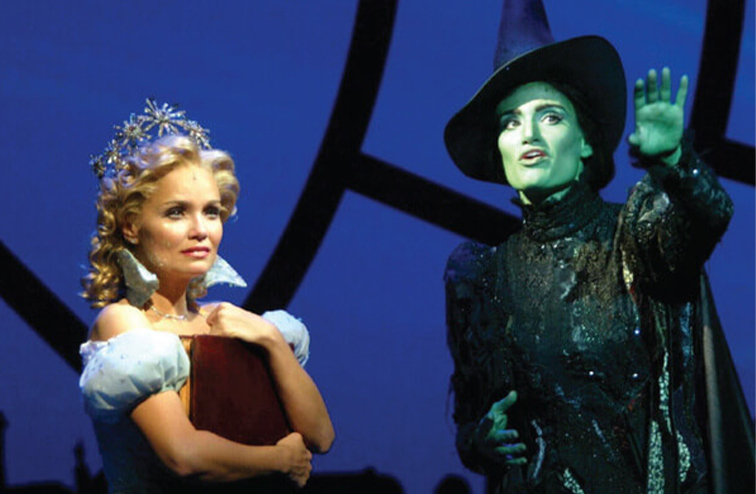
From her darkened hotel room, she called her mother, who told her, "You have what I have." Chenoweth recalls how she'd always dismissed her mom's frequent headaches, describing how she'd "hole up" for hours in her bedroom. As a kid, Chenoweth wondered why her mother "couldn't just get over it. I thought it was a housewife thing," she admits. "Now I have great empathy. For people who've never experienced migraine, I tell them to imagine a brain freeze and then imagine it not going away for hours, days, weeks."
That first episode in Virginia was soon followed by another, launching a repeating, every-two-months pattern that continued as Chenoweth struggled to balance a demanding career with debilitating symptoms. She remembers being scheduled to do a read-through of the musical Steel Pier for an audience of investors, but when she got out of bed that morning, she fell over and started vomiting. "I could not walk. The floor was spinning, with that falling—elevator feeling, and I had a ringing in my ear. I thought, 'What's wrong?'"
She somehow managed to work through this attack and several more. "I was in the crook of a piano singing. I felt the aura first. I was nauseous. Usually, I'm a physical singer. I move around and talk to the audience and the orchestra. Instead, I held on to that piano for dear life. I didn't move until the curtain came down. I needed assistance to get off stage. I couldn't see."
She knew she needed to seek help from a professional when she experienced an attack that lasted two weeks, forcing her to take a month-long leave from the 1998 Lincoln Center production of A New Brain. She wondered if she might actually need a new brain. While Chenoweth knew that no test could show that she was having a migraine, she underwent an MRI to rule out other serious brain disorders.
The brain scan indicated no other disorders. An inner-ear specialist diagnosed Chenoweth with vestibular migraine, which is characterized by migraine-associated vertigo and dizziness. Symptoms of this type of migraine can last five minutes to 72 hours, and sometimes even longer, says Teshamae Monteith, MD, FAAN, associate professor of clinical neurology and chief of the headache division at the University of Miami Miller School of Medicine. Chenoweth's condition is chronic, defined as 15 or more headache days per month for more than three months, with at least eight of those days involving acute migraine symptoms, according to the International Headache Society.
The inner-ear specialist also diagnosed Chenoweth with Meniere's disease, which explained the "falling elevator feeling" and ringing in the ears she was experiencing. Meniere's disease is a group of symptoms, including loss of balance (vertigo), ringing in the ears (tinnitus), a clogging sensation in the ears (aural fullness), and/or hearing loss, that often present together, says Robert Cowan, MD, FAAN, professor of neurology and chief of the division of headache medicine at Stanford University. "Many experts see Meniere's as a 'migraine-plus' syndrome," he says, adding that 35 percent of people diagnosed with Meniere's also experience migraine's head pain, nausea, and aura.
Chenoweth was prescribed injections of a triptan for acute migraine symptoms and calcium channel blockers to prevent future attacks. The combination helped alleviate the severity and frequency of her symptoms but did not knock them out entirely.
Changes in air pressure while flying, poor sleep, and even too much caffeine and sodium make Chenoweth more susceptible to a migraine attack, but her main trigger is light.
Knowing your triggers is key to managing or preventing a migraine, says Nina Y. Riggins, MD, assistant clinical professor in the division of headache and facial pain at the University of California, San Francisco. "The hypothalamus is involved in sleep, temperature regulation, appetite, urination, and the stress response, and can be connected to specific triggers, including lack of sleep, too much sleep, excessive heat, and hunger. One in three people with migraine say thirst can trigger attacks."
Susceptibility to individual triggers varies widely, says Elizabeth Loder, MD, MPH, chief of the headache division in the neurology department at Brigham and Women's Hospital and professor of neurology at Harvard Medical School. "Some people report that certain odors, such as strong perfume, can trigger an attack," she says. "Many women say they're more likely to get a migraine just before their menstrual cycles, when estrogen levels are falling after they've been elevated for a long time. However, and this is important, it's uncommon for fluctuating hormones to be the only trigger. In my experience, it's rare that someone will never have a headache outside of that menstrual window."