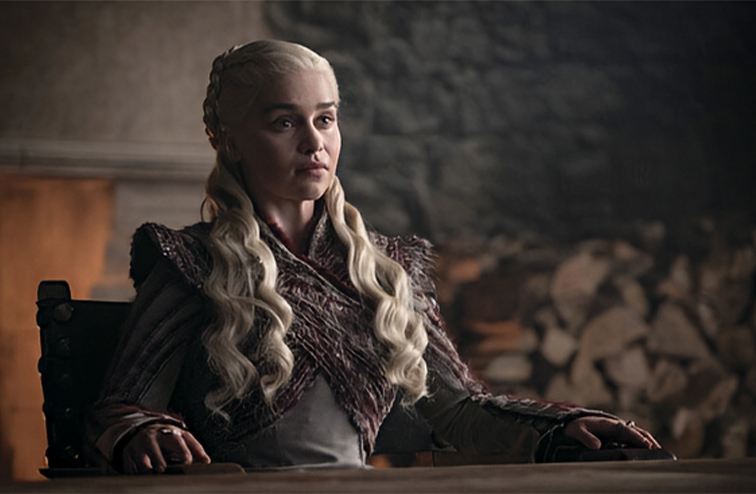
When Game of Thrones debuted on HBO in 2011, it gave then-24-year-old actor Emilia Clarke the first meaty role of her career: Daenerys Targaryen, otherwise known as Khaleesi of the Great Grass Sea, or Mother of Dragons. Clarke's performance as Daenerys would earn her four Emmy nominations as Game of Thrones went on to become one of the era's most talked-about shows, running for eight seasons and winning a total of 59 Emmys, including Outstanding Drama Series four times. In the course of playing an "incredibly strong woman," the British actor commented in a 2019 HBO video, "the strength I had to find to play her [allowed me to see] that I had that strength myself."
Shortly before the final season premiered in 2019, Clarke revealed the source of that strength in an article she wrote for the New Yorker: surviving two potentially fatal brain aneurysms during Game of Thrones' early years. She has now become a leading advocate for neurologic rehabilitation, and in April 2020 she was honored with the Public Leadership in Neurology Award from the American Brain Foundation, the philanthropic partner of the American Academy of Neurology whose purpose is to promote and invest in research across the spectrum of brain disorders. "I hope that people will find themselves more able to admit to having sustained a brain injury," Clarke says. "A stigma is still attached to it, and this must change."
Clarke's first aneurysm occurred in February 2011. She had just finished filming the first season of Game of Thrones and was feeling vulnerable and stressed by the responsibility of shouldering a big role in an attention-getting new TV series. Exercise helped her cope. But on that morning in a London gym, she experienced a headache so intense she could barely put on her sneakers. "I felt as though an elastic band were squeezing my brain," Clarke recalled in her essay. She made it through a couple of exercises before practically crawling back to the locker room, where she vomited as the stabbing pain in her head worsened.
What followed was a blur: a siren, an ambulance, jumbled voices, a brain MRI. And then a diagnosis: She'd had a subarachnoid hemorrhage, a type of stroke generally caused when an aneurysm—a balloon-like bulge in an artery—ruptures and spills blood into the space surrounding the brain.
"Subarachnoid hemorrhages are not a common cause of stroke—they account for an estimated 5 percent—but they are considered the most severe kind, with the highest fatality rate," says Vivien Lee, MD, FAAN, medical director of the Comprehensive Stroke Center at the Ohio State University Wexner Medical Center in Columbus. "Ten percent of people don't survive the trip to the hospital. Of those who do, another 25 percent die in the first 24 hours."
Clarke underwent a three-hour emergency procedure in which a catheter was inserted in her groin and snaked from her femoral artery to her brain, where a wire encased in the catheter released tiny platinum coils, which induced a blood clot that sealed off the aneurysm. Two weeks after the surgery, Clarke found she couldn't remember her name and spoke gibberish when she tried to talk—a common stroke-related language impairment called aphasia. Her dreams for an acting life seemed to be shattering. "In my worst moments, I wanted to pull the plug," she wrote in the New Yorker. "I asked the medical staff to let me die."
Fortunately, the aphasia passed after a week in the intensive care unit (ICU). (The weeks after such surgery carry a high risk of complications that can result in long-term disability.) Clarke could speak again and remember her name. She made plans to begin filming Thrones' second season in a matter of weeks. In total, she spent a month in the hospital. Yet she wasn't out of the woods. Doctors had detected a second, smaller aneurysm on the other side of her brain. It hadn't yet ruptured—and might never. Or it could rupture at any time.
For Clarke, the second season of Thrones was filled with anxiety, terrible exhaustion, and head pain severe enough to require morphine. "If I am truly being honest, every minute of every day I thought I was going to die," Clarke wrote. The uncertainty eased somewhat by season 3, and after filming was complete for that season, Clarke flew to New York to play Holly Golightly in a Broadway adaptation of Breakfast at Tiffany's. When Broadway.com asked in an interview what she liked about the Golightly character, Clarke replied, "She's a survivor."
While in New York City in the spring of 2013, Clarke went for one of the periodic brain scans that monitored her unruptured aneurysm. As long as it hadn't enlarged or otherwise changed enough to cause concern, doctors would not operate. But the bulge had doubled in size, so doctors recommended treating it right away rather than risking another burst. Her second minimally invasive catheter procedure was expected to go more smoothly than the first. Instead, she developed a massive brain bleed that required a different kind of emergency operation in order for her to survive: going through her skull to reach the aneurysm and stanch the bleeding. One of the complications of endovascular coiling is a perforation of the aneurysm, which occurs in 3.6 to 11.47 percent of cases, according to a 2017 study in the Journal of Cerebrovascular and Endovascular Neurosurgery.
Clarke came out of the surgery with a drain in her head, titanium substituted for bits of her skull, and a scalp-to-ear scar. "I looked as though I had been through a war more gruesome than any that Daenerys experienced," as she described it in the New Yorker. Even more daunting, she had to endure another monthlong hospitalization with the same high risk of complications.
Post-surgery, Clarke's head pain was excruciating, worse than it had been after her first aneurysm. She had panic attacks and worried constantly that she would sustain cognitive or sensory problems, such as not being able to concentrate, remember things, or see clearly. She recalls losing all hope and feeling like a shell of herself. At Comic-Con in July 2013, a couple of months after the second surgery, Clarke's anxiety swelled into fear that she was going to die. She also experienced a horrific headache just as she was about to do a Comic-Con Q&A session with several thousand fans. But she pushed through that event and a subsequent MTV interview.
As the months passed, Clarke began to feel better physically and mentally. In addition to Game of Thrones, she has co-starred in several high-profile movies, including Terminator Genisys, Solo: A Star Wars Story, Last Christmas, and Me Before You. Today, Clarke says, "I am at 100 percent."
While resuming her activities, Clarke has been mindful of the patients with brain injury she has encountered who were worse off than she was. Some never made it out of the ICU. Others were left with lifelong neurologic impairments. "She's very lucky," Dr. Lee says. "She probably did well because she had her youth going for her, and she's relatively healthy, which made her resilient. But that's a lot to go through."