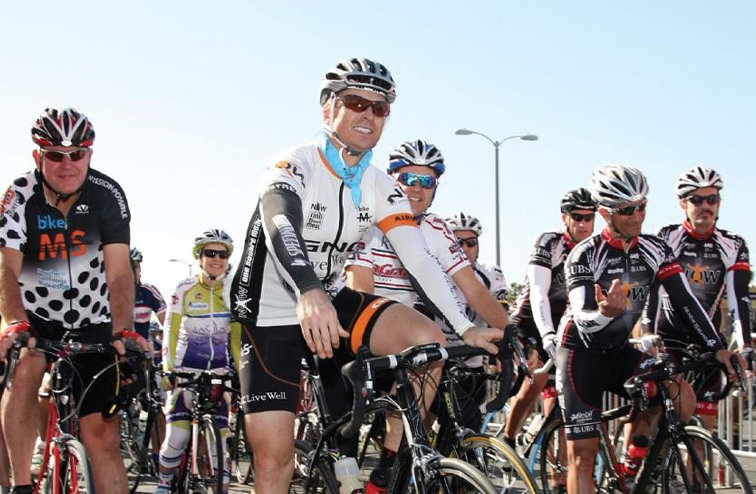
Phil Keoghan has long had a passion for pedaling. In 2013, the New Zealand native rode the entire 3,500-mile route of the 1928 Tour de France on a period bike. The accomplishment was the basis of a 2016 documentary called Le Ride. But it was an earlier ride that was ultimately life-changing. In 2007, Keoghan and his wife, Louise, were asked to sponsor an amateur cycling team. “It just so happened that this team participated in Bike MS rides, events that happen all over America,” says Keoghan, who knew little about multiple sclerosis (MS) then. No one in his immediate family or circle of friends had been diagnosed with the condition.
As he started getting to know people with the disease and learning more about the illness, he felt compelled to get involved. “My wife and I really enjoyed meeting men and women who live with MS and the people who support them,” says Keoghan, host of CBS’ reality show The Amazing Race since it started in 2001. His experience is echoed by others, says Lisa Guerette, president of the National MS Society's Southern California chapter. “A lot of people who participate in Bike MS do not have a close connection,” she says. “But they are moved by the mission and by the people they meet.”
Keoghan has given motivational talks at Bike MS fundraisers over the intervening years, has participated in the ride five times, and continues to meet and interact with people who have the disease. The series is one of the largest fundraising bike events in the world, according to its organizer, the National MS Society. Nearly 4,000 teams and 40,000 cyclists participate in the 50 rides of various distances held annually across the country; they have raised more than $1.5 billion since the series’ inception in 1980.
In 2011, Keoghan led a fundraising cross-country ride from Los Angeles to New York for the National MS Society. The 40-day, 3,500-mile endurance feat involved as many as 100 cyclists and raised almost $500,000 for the society. It was the basis for The Ride, a feature-length documentary, which raised another $200,000. That same year, Keoghan was honored for his philanthropy by the society at its annual Dinner of Champions, a fundraising event that raised $1 million, according to Guerette. The dinner is a chance to recognize those who have made meaningful contributions to the cause, she says. “His participation and support of the MS Society have been significant over the years. Whatever reason made Phil start, I'm sure he's met people who have motivated him to continue.”