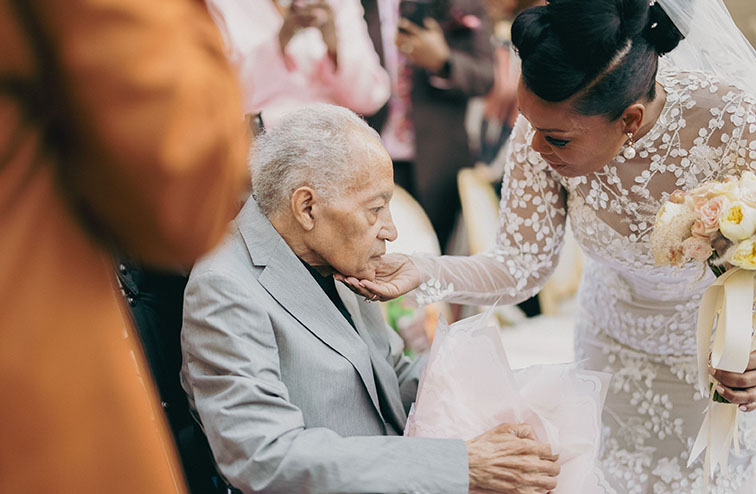
When Emmy-nominated actress Yvette Nicole Brown married her husband Anthony “Tony” Davis in December 2024, 200 of their friends and family members attended the romantic Beverly Hills ceremony, including many of her former castmates from the TV comedy “Community.” But the most special guest of all was a surprise even to the bride.
As the couple prepared to say their vows, Davis asked her, “Do you trust me?” She said she did, and he replied, “Okay. I'll be right back,” and walked away. “My friends thought I had been left at the altar,” Brown recalls. But Davis quickly returned—pushing her father, Omar, in a wheelchair. At the altar, Brown burst into overwhelmed, joyful tears.
Diagnosed with Alzheimer's disease more than a decade ago, Omar lives in a memory care facility near his daughter in Los Angeles, but his condition had declined to the point that it hadn't seemed possible for him to attend the wedding. “When we were making plans, I was thinking of how hard it would be to get him there, and would he understand where he was, and what if he needed to go to the bathroom or something,” Brown says. “And so I told myself that it just couldn't happen and I would have to accept that. But my husband realized that it would not be the same if he wasn't there.”
Privately, Davis spoke with his future father-in-law's caregivers, staff at the wedding venue, and medical professionals, arranging everything to ensure Omar could attend safely and with dignity. “When he pushed my dad up the aisle, there was not a dry eye in the room. Tony was crying. All my friends were crying. I was ugly crying, and I kept thinking, ‘Lord, don't let me cry these lashes off.’ I was trying to keep it as pretty as I could, but I was a mess,” Brown says, tearing up at the memory. “And Tony said to me, ‘We could not do this without him here.’ I will never forget the gift of that, because it's something that I never dreamed was possible.”
Brown's father, who served as head engineer at Maple Heights Middle School in her hometown of Cleveland, OH, for many years, started showing signs of dementia in 2013. She soon realized that he wasn't in a position to keep living on his own. “He was retiring from his job, and I had flown back to help him with the paperwork and get everything settled for his retirement. I had put together a binder with everything he needed—all of his financial documents, his Social Security card, his insurance, and so on,” she recalls. “But on my way back to California, by the time I got to the airport, he called to tell me he had misplaced the binder with everything in it. Anybody who found it and picked it up could have stolen his identity. He eventually found it, but that's when I first began to realize he would need to move in with me.”
At the time, she was still playing single mother Shirley Bennett in “Community,” which had an intense filming schedule. When NBC announced the show's cancellation in May 2014, Brown took it as the perfect opportunity to make the move. “They announced the show was canceled on a Friday, and by Sunday, I was in Ohio packing my daddy up to move in with me,” she says.
It marked the first time she had really lived in a home with her father, as her parents had divorced when she was about a year old and she always lived with her mom. “I'd make him bacon and eggs in the morning, I'd sit next to him and build Legos, and we'd listen to music or watch movies like ‘The Five Heartbeats,’” Brown says. “That movie could always bring him back—I swear I need to send them residual checks.”
When Yahoo! picked up “Community” for a sixth season a couple of months after her father's move, Brown met with the show's producers. “I asked them to release me, because the hours were just not conducive to me caring for my dad, and they did,” she says. “Three or four months after that, I was blessed to be cast on a reboot of the old ‘Odd Couple’ sitcom, and the hours on that show were more like 20 hours a week instead of 80 hours a week, so I didn't have to leave the industry completely. I was able to have an income, keep the lights on at the house, and still go home at lunch and check on my dad.”
At that point in his illness, Omar could still be alone for periods during the day, eat meals on his own, take the trash out, and handle other tasks. “He was still there,” Brown says. “As his condition progressed, I got caregivers who could come to the house, and we just worked it out. And then COVID happened, and we had like a year and a half where we weren't leaving the house anyway, so I was home with him.”