When renowned musician and conductor Itzhak Perlman checks in at an airport—something he does frequently with his busy international touring schedule—he often has the same frustrating experience. “I'll go up to the counter and they won't talk to me,” he says. “Instead, they'll talk to my assistant. ‘Where is he going? What's the weight of his scooter?’ I always have to say, loudly, ‘I'm right here.’ It's quite incredible.”
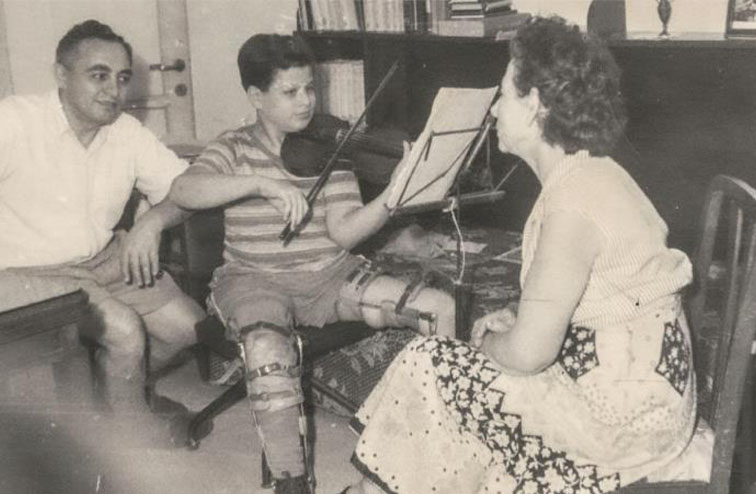
Perlman, who contracted polio when he was 4 years old, has walked with leg braces and canes for most of his life. Now 77, he primarily uses a motorized scooter to get around. Although he never sought the role of advocate for other people with disabilities, his fame has provided visibility, and his frequent travels have given him insight into the stigma and obstacles to accessibility people with disabilities face when they want to do something as simple as eat in a restaurant, go to a concert, stay in a hotel, or fly in an airplane.
“I haven't really taken on any formal advocacy positions recently, but I've done a lot of talking,” says Perlman, who performed at a state dinner for Queen Elizabeth II during George W. Bush's presidency and at the inauguration of President Barack Obama. He also has received 16 Grammy Awards, four Emmy Awards, the Presidential Medal of Freedom, and a Kennedy Center Honor. For decades, even before the Americans with Disabilities Act (ADA) was signed into law in 1990, Perlman would meet with architects and designers of performance venues to advise them on accessibility. “When they built the new David Geffen Hall at Lincoln Center in New York, I sat down with the architects, and we discussed all the things that would improve access to bathrooms, the box office, seats in the hall, and so forth,” he says.
In December 2022, Perlman returned to perform at Toronto's Roy Thomson Hall, which with its companion space Massey Hall is often called the “Carnegie Hall of Canada.” When Roy Thomson Hall was built in the early 1980s, Perlman consulted on the blueprints to ensure that it was accessible. “I hadn't been back since they renovated these spaces in the early 2000s, and I was delighted to see that they've changed the configuration of the hall and the seating to be even better than it was when I made my suggestions.”
Expectations at hotels
Concert halls may be increasingly accessible—some more so than others—but Perlman is less delighted with the approach that many hotels and restaurants take to accommodate people with disabilities. “When I go on tour, I find the hotel situation really quite horrible. I can count on the fingers of one hand the hotels I've visited that are truly accessible,” he says. “And the ADA sometimes is just used as a cover by architects who don't really understand what accessibility means. They put grab bars next to the toilet and in the shower and call it accessible. I've been in so-called accessible rooms where they have a bench in the shower for you to sit on, but the faucet is on the opposite wall. Who thought of that?”
He's also frustrated by the “luxury” touches in hotel rooms that end up making them less accessible. “In the fancy hotels, they have the beds very high and the toilets very low,” he says. “Between the high bed and the low toilet, forget about it. It's like climbing Mount Everest just to go to sleep. It's these little things that give you the feeling that people don't really care about what makes our lives easier.”
Perlman has learned to ask for photographs of the specific “ADA-compliant” rooms he will be staying in whenever he makes a hotel reservation. “I didn't used to do that, but now I do it all the time,” he says. “I don't want any surprises where I get into a room and can't reach something. And then there are certain restaurants that I don't go to because they have three steps to go down to the main floor or something like that. Shops also often have steps.”
Notable exceptions
Some places do accessibility well, he says. He cites a tactile paved pathway he saw in a shopping mall in Japan several years ago. “It's narrow, like a footpath, with raised dots so that your cane or even your feet can feel it and you can go straight. It's also yellow so that people with low vision can see it,” he says.
“London's black cabs all have ramps that fold out so a wheelchair user can roll right in, with passenger spaces big enough to fit the chair,” he adds as another example of good accessibility. “But that's rare. Whenever I go someplace and I have a free day, I want to get out and move, but it is very unusual to find ramp cars for rent like the one I have at home.”
Perlman's dream is to bring architects, interior designers, and decorators together with people who have a wide range of disabilities to discuss meaningful accommodations. “A summit like that would be fantastic, to discuss what it really means to have interior spaces that are truly accessible,” he says.
Embracing acceptance
Growing up in Tel Aviv, Israel, Perlman never really thought of himself as having a disability. “It was something I accepted without much bitterness, perhaps because it happened when I was so young,” he says. “When I went to school and they told me that gym was out of the question, it was not a big deal. I never thought, ‘Oh my goodness, I wish I could run like everybody else.’ In our neighborhood I had a lot of friends who played soccer, and I'd be the goalie and stop the ball from going through the goal because I had an extra set of legs—my braces. As a teenager, I played Ping-Pong and got pretty good at it. I'd hold my paddle with one hand and use the other hand to hold myself up.”