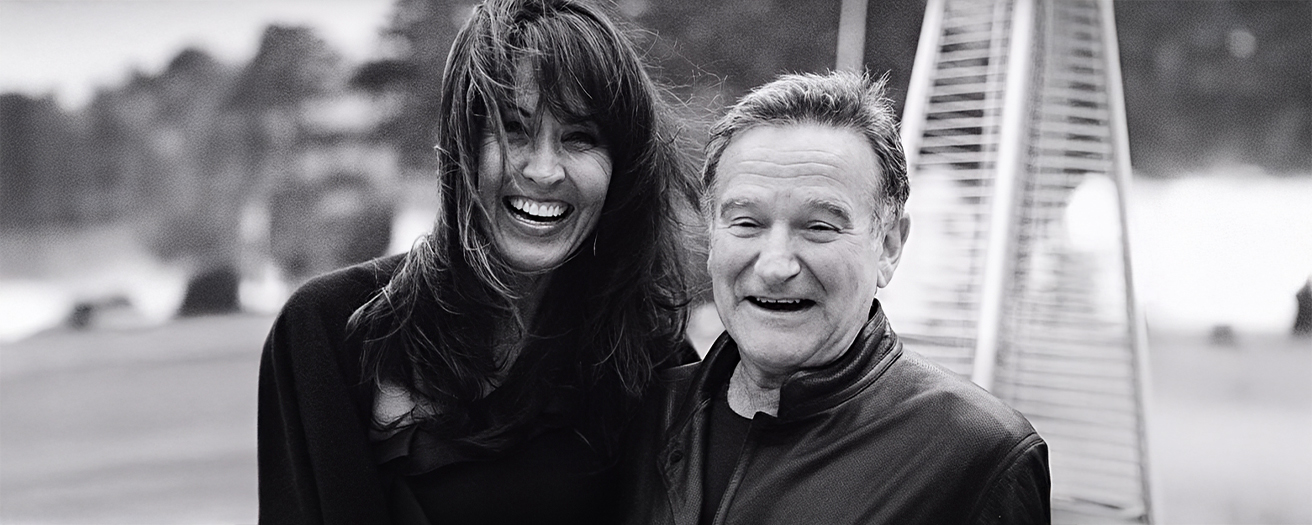
In the months before he died in 2014, Robin Williams began exhibiting troubling and perplexing symptoms such as mood swings, trouble walking, and hallucinations. The most intractable problem was anxiety, says Susan Schneider Williams, who married Robin in 2011. “We all have baseline moods and anxieties, and we get to know our spouse’s and loved one’s normal anxiety levels and triggers,” Schneider Williams says. “But Robin would remain in a heightened state of fear and anxiety that led to irrational paranoia. It was painful to watch, especially when it got to the point where nothing I could say or do would help.”
After seeing a raft of doctors, Robin was diagnosed with Parkinson’s disease, which explained the shuffling gait, tremor in his left hand, and parkinsonian mask that froze the features of his face. But it wasn’t the whole picture. “On one hand, I felt relief that the symptoms had a name. The neurologist talked about treatment options for Parkinson’s disease and mentioned that Robin had at least another 10 good years ahead of him,” Schneider Williams says. But Robin wasn’t convinced and asked if he had Alzheimer’s disease or schizophrenia. The doctor assured Robin that it was Parkinson’s disease and that he’d be fine.
“Looking back,” Schneider Williams says, “the diagnosis didn’t explain his other symptoms like visual hallucinations, sudden behavioral changes, delusional thinking, and paranoia.” Robin’s constellation of symptoms only made sense after an autopsy revealed that his brain was riddled with Lewy bodies. The neuropathologist who performed the autopsy said it was one of the worst cases of Lewy body dementia he’d ever seen. “Lewy bodies were just about everywhere in Robin’s brain and brainstem with a huge proliferation in the amygdala region,” says Schneider Williams.
A new purpose
Almost immediately, Schneider Williams began educating herself about the condition, which is the second most common cause of neurodegenerative dementia after Alzheimer’s disease. Lewy bodies are clumps of abnormal protein, primarily alpha-synuclein, which affect chemicals in the brain that can cause thinking, movement, mood, and behavioral problems. The disorder is named after Dr. Frederic Lewy, a German-born American neurologist who first identified these abnormal proteins. A major risk factor for the condition is Parkinson’s disease.
Once she felt knowledgeable about Lewy body dementia, Schneider Williams began educating others through interviews, speeches, articles, and visits to Capitol Hill to lobby for more research funds. In 2016, she joined the board of directors of the American Brain Foundation, a nonprofit organization in Minneapolis. Founded by the American Academy of Neurology in 1992, the foundation matches donors with researchers to cure brain disease. Schneider Williams has since ended her six-year term—she was vice chair during the last four years—and will continue to act as an advisor to the foundation’s Lewy Body Dementia Research Fund.
Schneider Williams also worked with director Tylor Norwood on the documentary, Robin’s Wish, which portrays the actor’s experience with the disease. Norwood collaborated with the Lewy Body Dementia Association to create a 45-minute adaptation called Spark: Robin Williams and his battle with Lewy Body Dementia to help educate the neurology community about the disease.