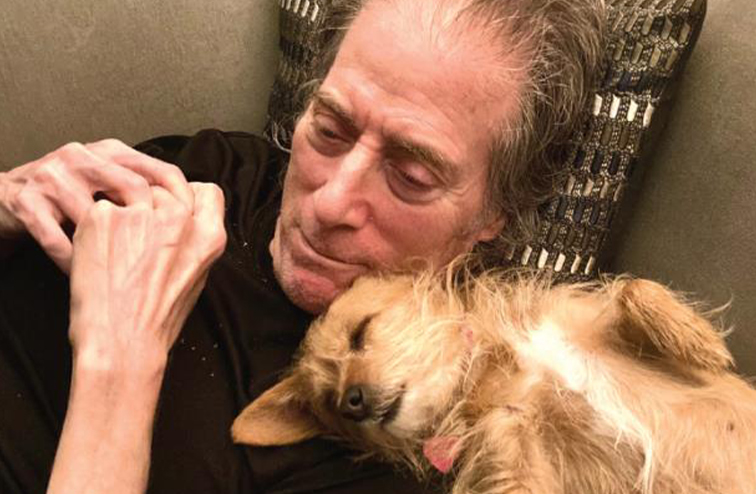
Lewis’ decades on the road as a comedian took a physical toll, and his health problems predate his diagnosis. “After 50 years of touring, I retired from stand-up on my own terms. Then it all hit the fan, and I've been in rough shape for a few years,” he says. “I have spinal stenosis and scoliosis. Since 2019, I've had sciatica-related back surgery, shoulder surgery, and reverse shoulder replacement surgery. Then while I was recovering, I tripped and broke my hip and needed hip replacement surgery.” He rattles off these ailments in a rapid-fire delivery. It's serious business, but he's hardwired to find a little humor in it.
Things got even more serious in 2021, when Lewis found he had to, as he puts it, “think about walking. Particularly in small, enclosed spaces, I'd stop and wouldn't know how to perform a simple action, like opening a door, without falling over. I was freezing. I also noticed stiffness in my walking, and I was shuffling my feet.”
Stiffness, shuffling, and “freezing”—the sudden inability to initiate or execute a movement—may not always be recognized as symptoms of Parkinson's disease. In fact, the neurologist Lewis saw initially didn't think Lewis needed to be tested. “Until I was walking out of his office and fell in the hallway,” Lewis says. The doctor promptly changed his mind and conducted a more thorough clinical evaluation, which ultimately confirmed the diagnosis.
Lewis’ experience highlights a common challenge for people with Parkinson's: A diagnosis can be elusive because the disease can appear gradually and be confounded by more common conditions such as spinal stenosis. “Not all patients have all the symptoms, and the gold standard for diagnosis remains the clinical history and neurologic examination performed by a physician with experience in movement disorders,” says Cheryl Waters, MD, FAAN, endowed professor of neurology at Columbia University Irving Medical Center in New York.
In addition to a wide range of motor symptoms, Parkinson's disease also has nonmotor symptoms such as loss of sense of smell, constipation, fluctuations in blood pressure, and a type of sleep disorder in which people act out their dreams, says Virginia Gao, MD, PhD, a fellow in the division of movement disorders at Columbia University's Vagelos College of Physicians and Surgeons in New York.
Other signs can include soft speech, small handwriting, difficulty with fine movements, and shaking or tremor, which occurs usually on just one side of the body. “People can sometimes have a sense of ‘internal tremor.’ They feel shaking in their bodies but no tremor is visible,” says Caroline Tanner, MD, PhD, FAAN, professor of neurology at the University of California, San Francisco.
Depression can be triggered or worsened by Parkinson's. Lewis, who has struggled with depression for years, sees a therapist and credits his wife, friends, and co-workers with helping him cope. “They bring me joy and remind me that I can fight the anxiety and depression from Parkinson's with things that bring me pleasure,” he says. Lewis was able to shoot a full season of Curb Your Enthusiasm after his diagnosis because he got so much support from the cast and crew.
Lewis, who is 76, sees his neurologist every three months. The doctor monitors motor functions, gait, and balance; determines whether the medications are still working and checks their side effects; and assesses Lewis’ nonmotor symptoms such as cognitive changes, mood, and sleep patterns. “I'm doing very well,” Lewis reports. “At my latest follow-up, I was in the best shape since my diagnosis.”