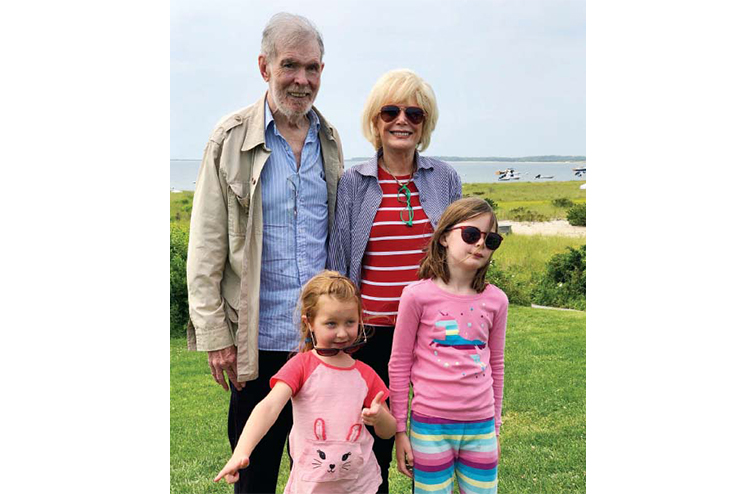
Her skills as an investigative reporter—a keen eye for detail, a relentless pursuit of the facts, and a steely resolve—have served 60 Minutes correspondent Lesley Stahl well throughout her decades-long career. More recently, she has applied those same skills to helping her husband, screenwriter and journalist Aaron Latham, manage his Parkinson's disease.
She first started noticing changes in Latham's gait about 11 years ago. "I'm a very slow walker, and his pace was slower than mine," she recalls. "We were on a trip with our daughter and her boyfriend, and she kept saying, 'What's wrong with Dad?'"
Other symptoms quickly followed, including stiffness, tremors, and a few falls, Stahl says. "He's very tall, and when he fell, it was awful. We have a flight of stairs in our house, and he fell down them. He hit his head on the street when he was walking the dog. He was fainting."
After a visit to his doctor and a full neurologic exam, Latham was diagnosed with Parkinson's disease and prescribed carbidopa-levodopa (Sinemet), a combination medication that supplies the brain with dopamine, a neurotransmitter and chemical messenger that is involved with motor function. The depletion of dopamine in the brain is believed to cause symptoms of rigidity, impaired balance, and tremor, says Caroline M. Tanner, MD, PhD, FAAN, director of the Parkinson's Disease Research, Education and Clinical Centers and division chief and professor-in-residence in neurology at the University of California, San Francisco (UCSF).
The medication improved, if not fully alleviated, most of Latham's symptoms, says Stahl. But the diagnosis ushered in a new chapter in the couple's life and one of Stahl's most challenging assignments yet: striking a balance between being a plugged-in health advocate and an empathetic spouse. Latham, who is now 74, prefers to downplay his diagnosis, a decision Stahl respects while still quietly using her professional contacts and skills to pursue innovative treatments. Over the years, they've found a way forward together despite setbacks, the unusual course of Latham's disease, and its inevitable progression.
A degenerative movement disorder
Parkinson's disease is a "neurodegenerative disorder that affects movement and speech," explains Dr. Tanner. Slowness of movement, or bradykinesia, is typical, she says. Other symptoms include tremors, muscle rigidity, and balance and gait problems, which occur on a spectrum of severity. "Every person is different, which can make diagnosis challenging at times," she adds. In addition, other conditions such as essential tremor, Alzheimer's disease, and progressive supranuclear palsy can be mistakenly diagnosed as Parkinson's. Latham's case was all the more challenging because his symptoms and disease course often seemed atypical.
Cause unknown
"Most of the time, we don't know what causes Parkinson's," says Dr. Tanner. "Only 10 or 15 percent of patients have strong genetic determinants, and not everyone who has a gene defect ends up getting the disease. We think it's a combination of genetic predisposition and environment, in most cases. It's a multifactorial disorder."
A disturbing side effect
While carbidopa-levodopa helped to reduce Latham's tremor, rigidity, and fainting, and improved his slower gait, he developed a distressing side effect, says Stahl. "He had this horrible facial tic—really quite disfiguring. He couldn't control it, and it made it hard for him to eat and chew."
He endured the tic until Stahl happened to interview Oliver Sacks, the renowned neurologist who died in 2015, for a panel discussion at the 2012 World Science Festival in New York City. During the discussion, which focused on the ability of music to heal patients with severe neurologic problems, the subject of medication came up.
Dr. Sacks talked about how carbidopa-levodopa gives people tics," Stahl says. "No one had ever said that to us." When Latham, who was in the audience, heard what Dr. Sacks said, he stopped taking his medication, says Stahl—without telling her or his doctor.
Sudden suspension of symptoms
At some point after the event with Dr. Sacks, Stahl noticed an overall improvement in Latham's health—and subsequently learned that he'd stopped taking his medication. The family was on vacation with their daughter, son-in-law, and first grandchild when Stahl noticed that Latham was walking at his old pace, which was faster than hers, and no longer had a facial tic. "He hadn't been able to drive since the summer before. Now he could drive again," she says. "He was completely symptom-free."
For almost a year, Latham remained symptom-free, and the couple began to wonder if he had been misdiagnosed. So they began seeing a new round of doctors. After various misdiagnoses, including West Nile virus and Lyme disease, the couple flew to Boston to seek another opinion. The neurologist they consulted said that it was possible for symptoms to vacillate, but that Latham most likely still had Parkinson's disease and the symptoms would return.
An ebb and flow of symptoms can happen, especially in the early stages of the disease, but it's not typical, says Dr. Tanner. "For 99 percent of people with Parkinson's, the long-term course is worsening, not improving, of symptoms. Withdrawal from medications may look good in the short run, but eventually symptoms return with progressive disability."
To Stahl and her husband's great disappointment, Latham's symptoms did just that. After an unrelated health crisis—a dangerous blockage in his colon—and an operation, Latham's symptoms returned worse than ever, says Stahl. Once again, they were dealing with stiff limbs, a halting gait, tremor, and fainting spells.
Risky business
Given his abrupt discontinuation of his medication, Latham was lucky not to experience serious health consequences, says Dr. Tanner.
"It's not safe to stop carbidopa-levodopa," she says. "Doing so can impair your ability to move, maintain your balance, or even swallow. It can be life-threatening. Patients should always discuss medication with their doctor before making any changes in their dosage."
Dr. Tanner also believes that the severe tic Latham experienced was likely dyskinesia, involuntary movements that can happen anywhere in the body, including in the face, in people with Parkinson's disease.
Still writing
For Latham, who penned the Esquire article and screenplay that became the 1980 film Urban Cowboy, the physical symptoms of Parkinson's disease have been professionally challenging. Typing has become increasingly difficult as his tremors and rigidity worsen. And his once "lovely cursive" handwriting is now "scratchy and pinched," says Stahl.
"He's semi-retired, but he continues to write; it just takes longer now," she adds. He's also started directing plays, which, his devoted spouse says, "he's really good at."