Forward functioning
Movement symptoms of Parkinson's disease, such as tremor and small handwriting, occur when neurons responsible for producing the chemical messenger dopamine have been damaged or lost in an area of the brain called the substantia nigra. The brain needs dopamine for smooth and purposeful movement, among other functions. A loss of dopamine can cause a range of symptoms, including slowed movement, muscle stiffness, and difficulty with walking and balance.
Most people develop the disease around age 60, so a diagnosis before age 50 is considered early onset. "It's degenerative, so I assumed it gets worse and worse, but I didn't know when or how much," says Bill, who was diagnosed at age 47. "I still don't know what will happen day to day."
"People often think of Parkinson's as an old person's disease, but younger people can have it," says Alfonso Fasano, MD, PhD, professor of neurology at the University of Toronto. While one person's experience of the disease can differ greatly from another's, all share one reality: "We don't have a cure," Dr. Fasano says. "We do, however, have good symptomatic therapies, and the majority of people with Parkinson's live a normal life for many years."
Bill is part of that majority, and he credits his attitude with helping him manage his diagnosis. "I didn't want to think about Parkinson's, didn't want to let it into my life, into my house, didn't want it to be the first thing people thought of when they saw me," he writes in Good Talk, Dad.
He was also aware that the disease can flatten emotions and cause depression, and he worked hard to fight that. "My whole life I was a person who would come into a room and liven things up and be fun to have around," Bill says. "I couldn't deal with losing that."
Bill didn't just keep his disease from his kids. He hid it at work, too, partly out of concern that CBS might bench him. Although much progress has been made in lifting the stigma around the disease, especially since actor Michael J. Fox announced his diagnosis in 1998, the atmosphere was different 30 years ago. "There was not as much protection for people," says Janis Miyasaki, MD, FAAN, director of the Parkinson and Movement Disorders Program at the University of Alberta in Edmonton. "Bill may have been justifiably concerned about an employer's ability and willingness to support him."
Though he struggled with symptoms, Bill forged ahead. "The fact that he was able to function at work and keep a busy schedule traveling around the country speaks to his strength and resilience and the fact that people can live well with Parkinson's," says Dr. Miyasaki. "It's helpful to focus on what you can do, not on what you can't do or have difficulty doing. Some people have a harder time with Parkinson's than others through no fault of their own."
Bill's relatively stable disease course, in which his symptoms progressed slowly, is a pattern more often seen in early-onset cases. "For some people, disguising Parkinson's is impossible," says Alberto Espay, MD, FAAN, director of the James J. and Joan A. Gardner Family Center for Parkinson's Disease and Movement Disorders at the University of Cincinnati Academic Health Center. "Being able to avoid declaring his disease to others for more than a decade suggests he has a type of Parkinson's that is sometimes referred to as 'benign Parkinson's,' though there's nothing benign about it from a practical perspective."
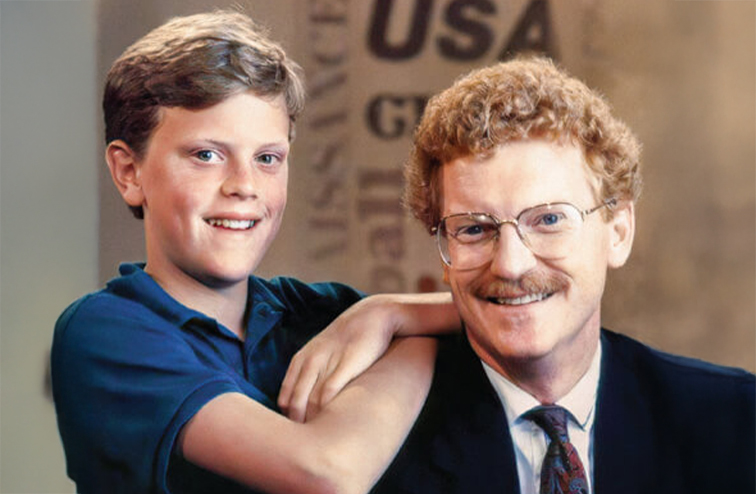
At home, Bill seemed well enough that Willie—in high school when his father was diagnosed—didn't take much notice. But he and his sister weren't oblivious. "Senior year I remember things that made me think Dad was getting old," Willie says. One was Bill reaching up to open the car's sunroof. "I can't say why that image is seared into my memory," Willie says. "He was just slow and not moving the energetic way I remembered."
Bill's slowness, naps, and occasional self-isolation gradually raised questions. "My mom would say, 'He's got a neurologic thing and takes medication for it, and the doctors say they can manage it,'" Willie says. "In hindsight, that shouldn't have been good enough for us, but they said it was under control—and it did seem to be. Dad never complained and never wanted to talk about it. We followed his lead."
Eventually, Bill felt a need to come clean about what was happening during those times when the family got together. "I was really tired and taking naps when they were going places," Bill recalls. "Then my wife said something offhand. She said, 'You wouldn't want to give them the idea that you don't like them,' which couldn't be further from the truth."
Bill gave the go-ahead for Jody to tell the children he had Parkinson's disease. The news was so unsurprising that Willie can't remember the moment he found out. "It was like, 'Oh...Oh!'" Willie says. "We had figured it out, but being told made it seem more serious."
CBS viewers eventually started wondering what was up as well. "People noticed I was moving my head and jerking a bit," Bill says. "We were getting letters at work asking, 'What's wrong with Bill?'" Finally, in 2012, two decades after his diagnosis, he announced on CBS Sunday Morning that he had Parkinson's disease.
"It was a big moment," says Willie, who had gathered in the living room with his wife and parents. "We were watching, applauding, and crying a bit." Willie has said he's never felt prouder as a son because it took courage for Bill to speak publicly about his condition. "He's charming and funny," Willie says, "but over the course of 30 years, he's also been tough."
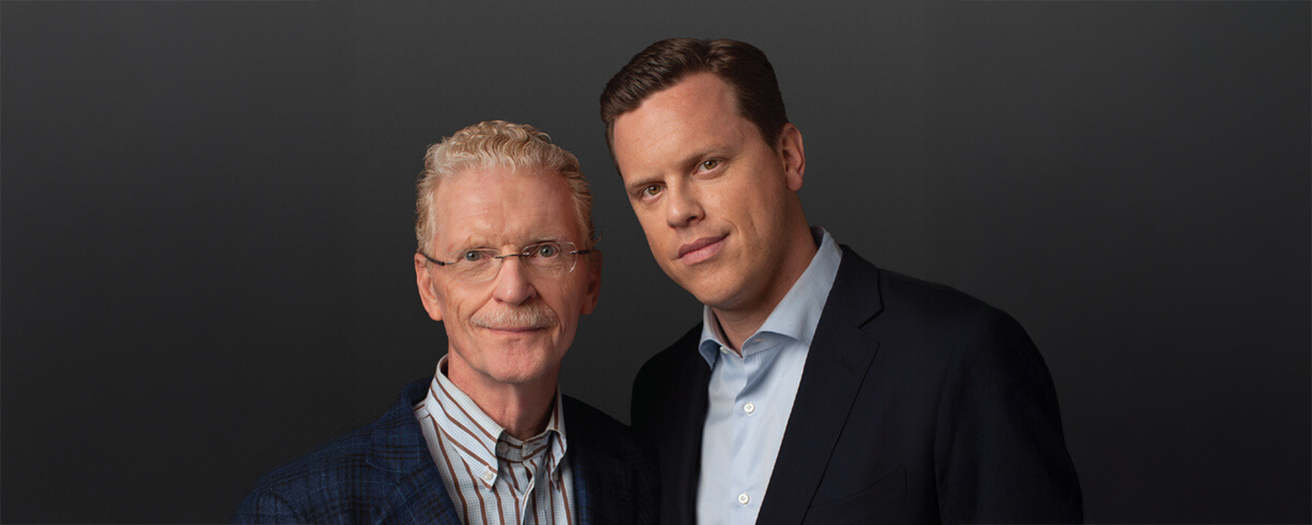
The family experience has led both Willie and Bill to advocate for Parkinson's disease awareness and research through organizations such as the Michael J. Fox Foundation, where Willie serves as a board member. "I try to be a proxy for Dad, tell his story if he's not up to it, and use his story to help other people," Willie explains.
Deep brain stimulation
The Michael J. Fox Foundation's projects include investigating patient experiences with deep brain stimulation (DBS), a surgical treatment for Parkinson's symptoms that Bill received three years ago. "DBS is like a pacemaker for the brain," Dr. Fasano says of the procedure, which entails implanting electrodes that modulate activity in targeted regions of the brain to alleviate motor symptoms. "It's not a cure for Parkinson's, but for certain patients and some symptoms it's one of the strongest therapies we have."
"The brain surgery really helped with the involuntary movement," Willie says. "He still has trouble walking but doesn't move around when sitting in a chair." Bill also takes medications, which Jody manages and helps make sure he takes every two hours and 45 minutes. The couple recently celebrated their 50th wedding anniversary. "My wife is tremendous," Bill says. "Parkinson's has made our marriage stronger because I appreciate how much she does and the kind of person she is. I don't think I fully recognized before the total devotion she has." Jody helps so much that "she essentially has the same disease I do," Bill says.
He says he feels guilty for planning activities that he might have to cancel at the last minute, as happened with a vacation to Greece a few years ago. "I plan things that sound fun," Bill says, "but when it gets down to thinking about the physical thing, like having to get into a car or a boat, I realize I signed up for more than I can do. I'm still a little bit in denial."
During the COVID-19 pandemic, even some activities he can do have been curtailed. A physical therapy program he attends four times a week closed from March to July 2020. "We work on turning around and walking, and they even have a boxing element to it," Bill says. "I trade punches with the physical therapist and hope we're in sync so I don't knock her out."
Going to therapy also provides social and cognitive stimulation. "He has relationships with people there, joking and telling stories," Willie says. "Dad needs that interaction to stay sharp." That's especially true as typing or writing by hand becomes more difficult. "I'm experimenting with using my voice to type," Bill says. "I don't know if you can write literature that way. So that's disappointing, and I'm worried about it."
Willie says keeping his father engaged has been one of the biggest challenges of the pandemic, along with how it's restricted family get-togethers. "We're very careful," Willie says of his parents' contact with him, his wife, and his two young children. "It's difficult for everyone because we want to be there, spend time, and take some of the heat off Mom," he says. The families live about a half hour apart in the New York City suburbs and gather occasionally "at a distance," Willie says. "I can't give Dad or Mom a big hug."
More often, they talk by phone or on Zoom. "I'll have the phone in my lap and think, 'Eh, I'll call tomorrow'—but then I'll just call anyway," Willie says. "I'll have no real agenda. I talk to Mom, she passes it to Dad, and we talk about baseball. I'm thinking more and more that there's just a finite time we're all here, and let's make sure the days are good and memorable and that Dad gets joy out of them."