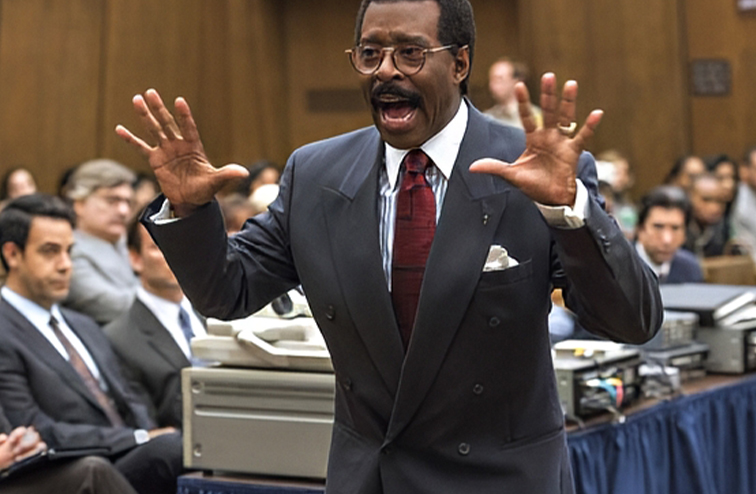
Courtney B. Vance, a Tony and Emmy Award-winning actor, can locate the essence of his mother's character in a single, quiet scene. He was a high school senior at Detroit Country Day School, a private college prep school. His mother, Leslie Vance, was a librarian at a neighborhood branch about a mile from their home. "I said something about her 'little job at the library,'" Vance recalls. "She got quiet, and I recognized immediately that I'd made a mistake." Flashing her expressive eyes, she said, "Courtney, this 'little job' of mine allows you to go to that damn school," and walked away.
That one line summed up his mother perfectly—her strength, discipline, love, sacrifice, and belief in the value of hard work and education. Those values, which both of Vance's parents instilled in him and his older sister, Cecilie, drove him to academic and athletic excellence at Country Day. Artistic excellence followed as an undergraduate student at Harvard, where Vance discovered theater.
His gift for channeling his emotions into characters took him to a master's program at the Yale School of Drama in the mid-1980s. Soon after graduating, he landed roles in movies, on television, and in plays, including the 1987 Broadway debut of August Wilson's Pulitzer Prize-winning Fences and the 1990 film The Hunt for Red October. Vance has had a steady succession of roles ever since, including his portrayal of attorney Johnnie Cochran in the FX series The People v. OJ Simpson: American Crime Story, for which he won the 2016 Emmy Award for Outstanding Lead Actor in a Limited Series or Movie.
Recent years have brought deeper insights into his mother's strength, fortitude, and love. Once again, this new chapter hinged on a quiet moment. It was 2012, and Vance's life seemed full of blessings. In 1997, he married Angela Bassett after meeting the Academy Award-nominated actress at Yale. They'd had twins, a boy and a girl, in 2006, published their joint memoir Friends: A Love Story shortly after that, and were landing good roles. The family had gone to visit Vance's mother in Detroit when their then-6-year-old son made the kind of unfiltered comment children are known for: "Grandma, why are you talking funny?"
A difficult diagnosis
"She was slurring her speech," Vance says. "We'd all heard it, but we thought it was her dentures or didn't want to embarrass her, so nobody said anything." Once the slurring was out in the open, Vance's mother had it checked out. Her doctor and dentist couldn't identify a problem. But acting on an intuition, she saw a neurologist, who finally made the devastating diagnosis: She had amyotrophic lateral sclerosis (ALS).
ALS comprises a group of neurologic diseases that primarily affect neurons controlling voluntary muscle movements, such as those needed for talking, chewing, and walking. As neurons progressively degenerate and die, people with ALS gradually lose the ability to speak, eat, move, and breathe. About 50 percent of people with the disease die within three to five years, usually from not being able to breathe. "About a third of cases start with speech and swallowing difficulties," says Mark Bromberg, MD, PhD, FAAN, professor of neurology and chief of the diagnostic and clinical neurology division at the University of Utah and author with his wife, Diane Banks Bromberg, of Navigating Life with Amyotrophic Lateral Sclerosis. The cause of ALS is not known, and there is no cure.
"ALS is nightmarish," Vance says. "My mother was a very active 78-year-old who had many friends and was involved with many community organizations. To go from that to what you know ALS is—it's an awful transition."