A change in your vision—flickering lights, a blind spot, a patch of the world gone gray—is one of the most unsettling things a person can experience, and it sends a lot of people googling “ocular migraine.” Here’s what you need to know, and why it matters.
What is ocular migraine and how is it treated?
Ocular migraine isn’t an official diagnosis. It’s a term used for two very different conditions—and telling them apart is essential for getting the right care.
By Olivia Begasse de Dhaem, MD, FAAN
August 19, 2026
Key takeaways
- “Ocular migraine” isn’t a formal diagnosis; it usually means either migraine with visual aura (which affects both eyes and typically resolve on its own within an hour) or retinal migraine (which affects one eye and needs a medical professional to evaluate).
- The fastest way to tell migraine with visual aura and retinal migraine apart is to cover one eye at a time.
- If the visual disturbance is in only one eye, see an ophthalmologist or emergency department immediately.
- Migraine with visual aura is common and usually harmless on its own, but it is linked to higher stroke risk; smoking and estrogen-containing contraceptives raise risk further.
What is ocular migraine?
Ocular migraine is actually not a formal diagnosis. It’s just a common term applied to two distinct conditions, but they both have visual disturbance and sometimes headache: migraine with visual aura and retinal migraine.
How can I tell which type of migraine I’m having?
Cover one eye, then the other. If the visual disturbance is still there no matter which eye you cover, it’s coming from your brain—that’s migraine with visual aura. But if the disturbance disappears when you cover one eye, the problem is in that single eye, and that requires same-day evaluation by an ophthalmologist or an emergency department. The one-or-both-eyes test can be hard to do in the moment. Even though I treat patients with headaches every day, the first time I experienced migraine with visual aura myself I had a hard time remembering to the do eye cover test.
What is retinal migraine, and why is evaluation urgent?
Retinal migraine is a rare type of migraine. Symptoms include quick flashes or sparkles of light (scintillations) or a graying, dimming, or partial-to-complete loss of vision in one eye. This usually happens right before or during a headache and lasts less than an hour. These symptoms are urgent because they are rarely caused by retinal migraine and could be a sign of something more serious like a blocked retinal blood vessel, giant cell arteritis (an inflammation of the arteries that can reduce blood flow to the eye), or a problem in the carotid artery such as an atherosclerotic plaque. We can’t assume a retinal migraine diagnosis until those are ruled out.
What does migraine with visual aura typically look like?
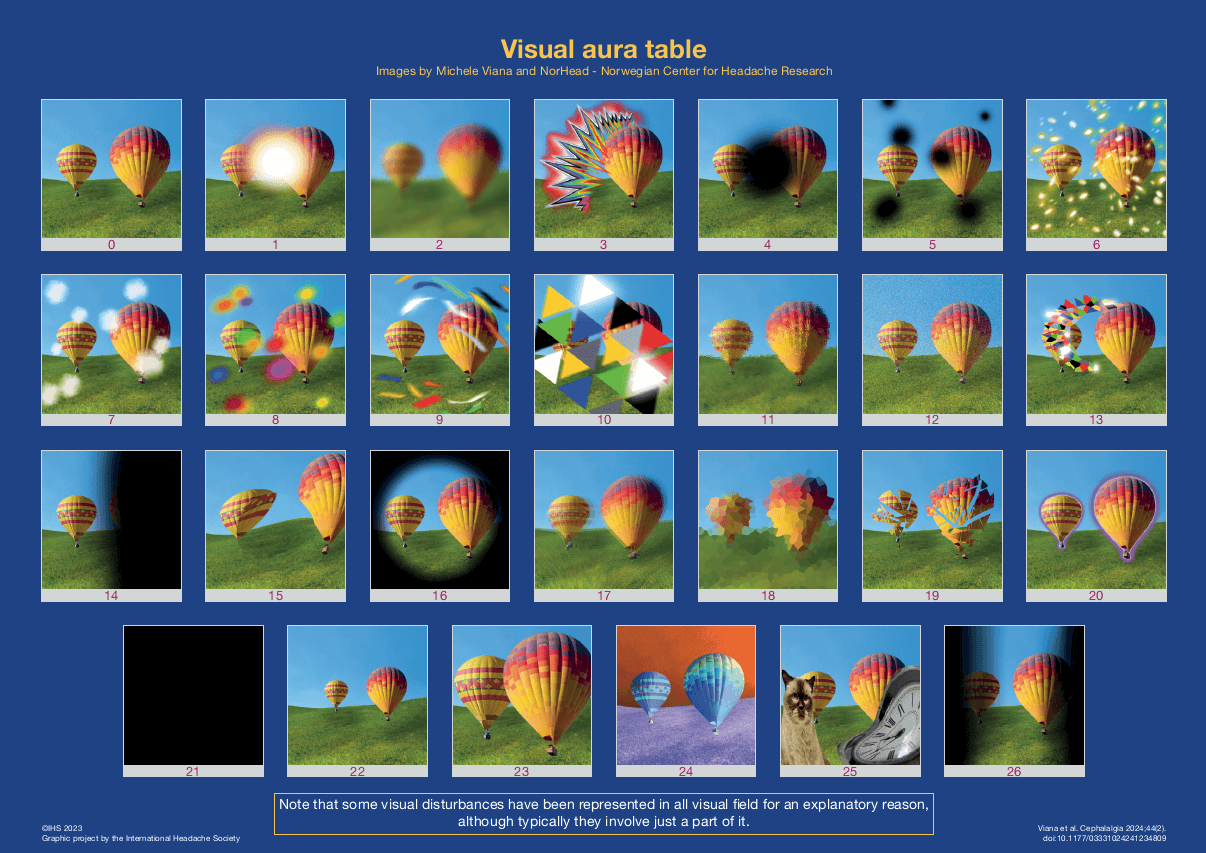
Visual aura varies. Classic aura is a shimmering zigzag, a sparkling C-shaped arc, or a blind spot with a bright, jagged edge that slowly expands across your field of view. It typically builds over at least five minutes, lasts somewhere between five minutes and an hour, and then fully resolves. Sometimes a headache follows; sometimes there’s no headache at all. The International Headache Society now offers a Visual Aura Table so you can show your doctor an image that matches what you saw.
What causes migraine with visual aura?
Visual aura is thought to come from a slow wave of unusual brain activity (known as cortical spreading depression) across the surface of the brain. Some factors like changes in estrogen are associated with aura. Some people notice their aura shifts with the menstrual cycle or worsens during pregnancy.
Does migraine with visual aura raise my stroke risk—and what about birth control?
We’ve long known migraine with aura is associated with a slightly higher risk of ischemic stroke—when blood flow to part of the brain is blocked. A 2026 study suggests that people who experience aura have a higher relative risk of stroke when compared to people without migraine, while those with migraine without visual aura show no increase in risk of stroke.
Even though the risk of stroke is higher in people with visual aura, the risk is relatively low in both groups. At this time, there is no evidence that migraine treatment reduces stroke risk. Still, it’s important to reduce modifiable risk factors like smoking and estrogen-containing birth control. Both of these raise stroke risk further when aura is present. It’s important to talk to your doctor about what is best for you.
Can I treat migraine with visual aura myself?
Visual aura doesn’t usually last long and resolves on its own, so treatment is mostly focused on prevention. For an accompanying headache, standard migraine acute treatments such as nonsteroidal anti-inflammatory drugs (NSAIDs) or prescription medications work best. For prevention, magnesium is one of the better-studied over-the-counter options and helps some people. Discuss prevention and treatments with your doctor.
Dr. Olivia Begasse de Dhaem is a neurologist, headache specialist, and assistant professor of neurology at the University of Connecticut.
– As told to Robert Firpo-Cappiello
Free brain health insights
Our email newsletters deliver tips, resources, and inspiration straight to your inbox.